Case 2026-07-12 — 15 MW Solar Generation Facility, California
Introduction
A 15 MW solar generation facility in California relied on ZTZ Services continuous online bushing monitoring to detect progressive insulation degradation in a 69 kV step-up transformer bushing.
Site Description
The monitored site is a small-scale solar photovoltaic generation facility rated at 15 MW, located in California. The facility interconnects to the utility grid through a single step-up power transformer that elevates the generator output voltage to 69 kV for transmission. The high-voltage (HV) side of this transformer is equipped with 69 kV oil-impregnated paper (OIP) condenser-type bushings.
Monitoring System Installed
ZTZ Services installed its ZVCM-1001 bushing monitoring system on the step-up transformer. The ZVCM-1001 simultaneously monitors all three high-side bushings (H1, H2, and H3), measuring multiple parameters on a continuous basis.
Monitoring Evidence
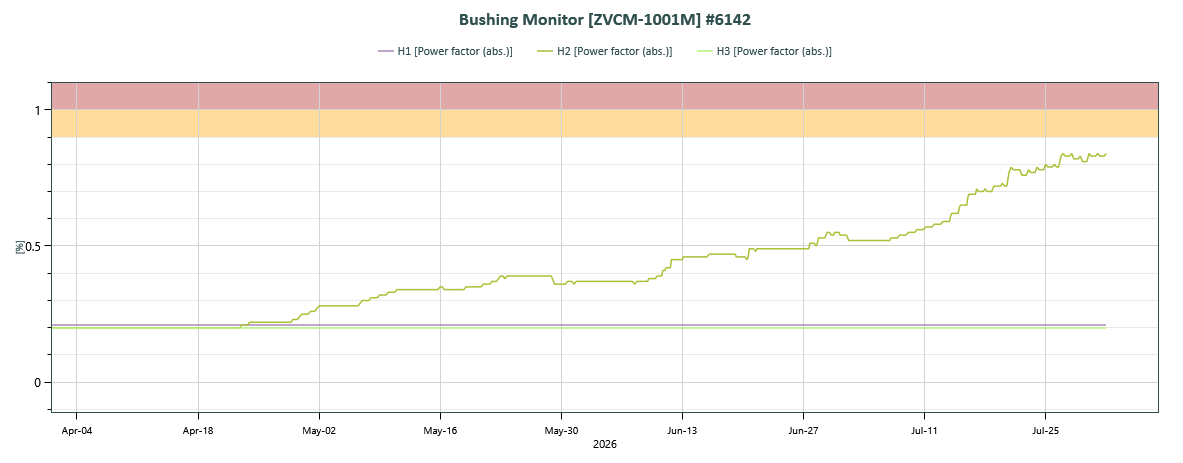
Continuous trending of bushing power factor revealed a clear and progressive deterioration signature on the H2 bushing over a four-month period, while H1 and H3 remained stable — providing unambiguous evidence of a single-phase insulation defect.
Trend Data: Four-Month Power Factor History
The chart reveals the following:
- H1 and H3 power factor remained essentially flat throughout the entire monitoring period, hovering near 0.20% — consistent with healthy bushing insulation at nameplate condition.
- H2 power factor began the monitoring period near 0.20% in early April 2026, consistent with H1 and H3. From that baseline, H2 exhibited a steady, progressive upward trend through spring, reaching approximately 0.50% by late May 2026.
- The rate of increase accelerated through June and July 2026, with H2 power factor approaching 0.85–0.90% by late July — entering the system’s warning (orange) threshold zone.
The divergence between H2 and the reference phases (H1 and H3) is the defining diagnostic signature of single-bushing insulation degradation. In a healthy transformer, all three high-side bushings of the same design should exhibit closely matched power factor values under identical operating conditions.
Real-Time Dashboard Readings
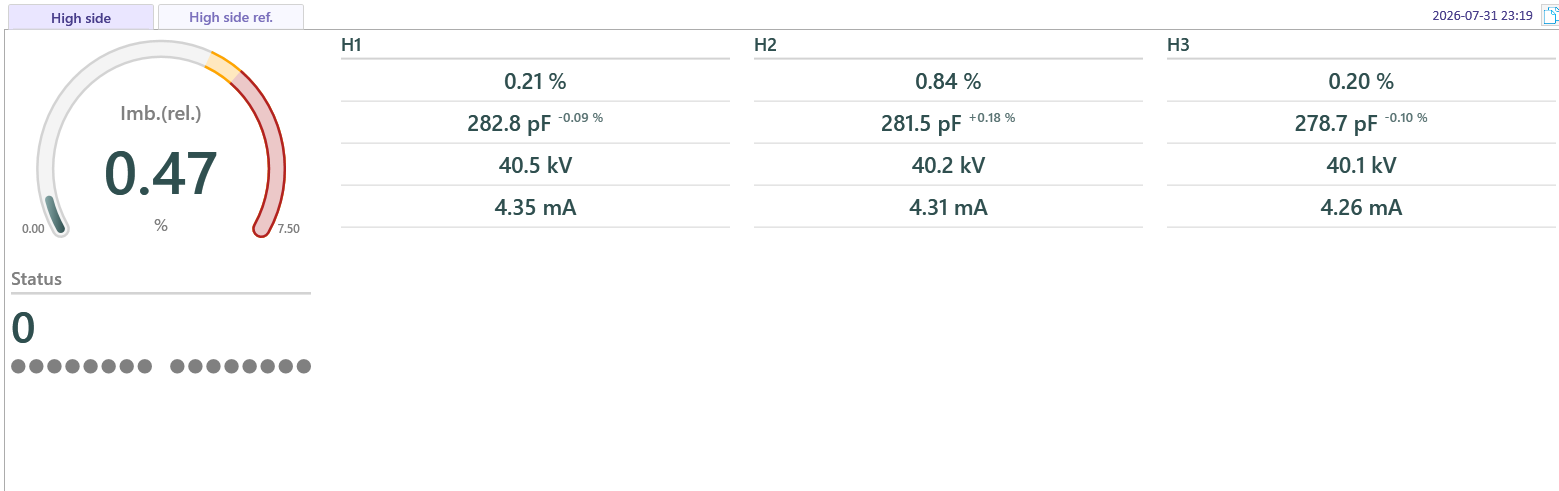
At the time of the case documentation (July 31, 2026 at 23:19), the ZTZ online monitoring portal dashboard confirmed the elevated H2 condition in real time.
Interpretation: Indicators of a Degraded Bushing
Taken together, the trend data and dashboard readings present a coherent picture of progressive insulation degradation in the H2 bushing:
- Rising absolute power factor is the primary indicator of dielectric deterioration.
- Stable capacitance with slight positive deviation is consistent with early-stage degradation.
- Phase selectivity rules out system-wide causes such as voltage distortion or measurement error, and points to a defect localized within the H2 bushing assembly.
- The gradual, consistent rise over four months rather than a sudden step change is characteristic of accelerated insulation aging, and provides the time margin necessary for planned intervention.
ZTZ Services Technical Expertise and Actions
Upon detecting the progressive H2 power factor anomaly, ZTZ Services engineers confirmed the degradation signature, assessed trending risk, and coordinate a timely planned intervention to prevent an uncontrolled failure.
This case illustrates several principles that are applicable to transformer asset management at solar generation facilities:
- Trend monitoring outperforms threshold alarms. The H2 anomaly was identified and acted upon while still in the warning zone, before any hard alarm threshold was breached. Threshold-only monitoring would have provided a much shorter response window, or none at all in the event of rapid deterioration.
- Phase comparison is a powerful diagnostic tool. The stability of H1 and H3 throughout the monitoring period provided an unambiguous reference baseline, making the H2 anomaly immediately interpretable as a single-bushing defect rather than a system-wide condition.
- Solar step-up transformers warrant continuous monitoring. As the sole interconnection point between a generation asset and the grid, the step-up transformer is a single point of failure. The cyclical thermal and electrical stress profile of solar generation accelerates insulation aging. Continuous monitoring is the appropriate risk management strategy for this asset class.