
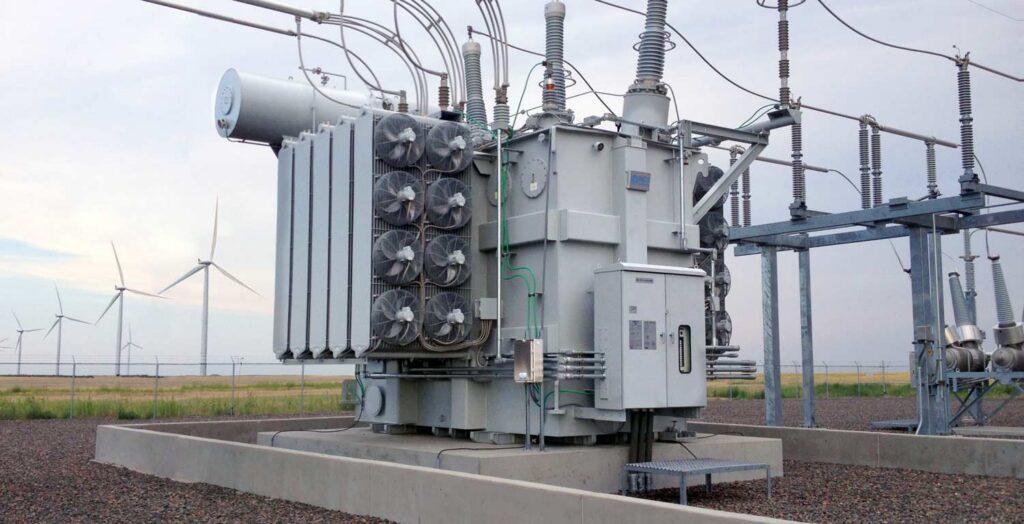
If AI is going to power the U.S. into tomorrow, how will the national grid power energy-hungry AI data centers today?
The surge in artificial intelligence applications and hyperscale data centers is reshaping electricity demand in ways few anticipated just a few years ago. Data centers consumed about 176 TWh in 2023—roughly 4.4% of total U.S. electricity—and projections from the U.S. Department of Energy show this could climb to between 325 and 580 TWh by 2028, accounting for 6.7% to 12% of national consumption[1] . That’s effectively a doubling or tripling in just a handful of years, driven largely by AI workloads that demand massive, continuous computing power.
The AI Onslaught on the Horizon
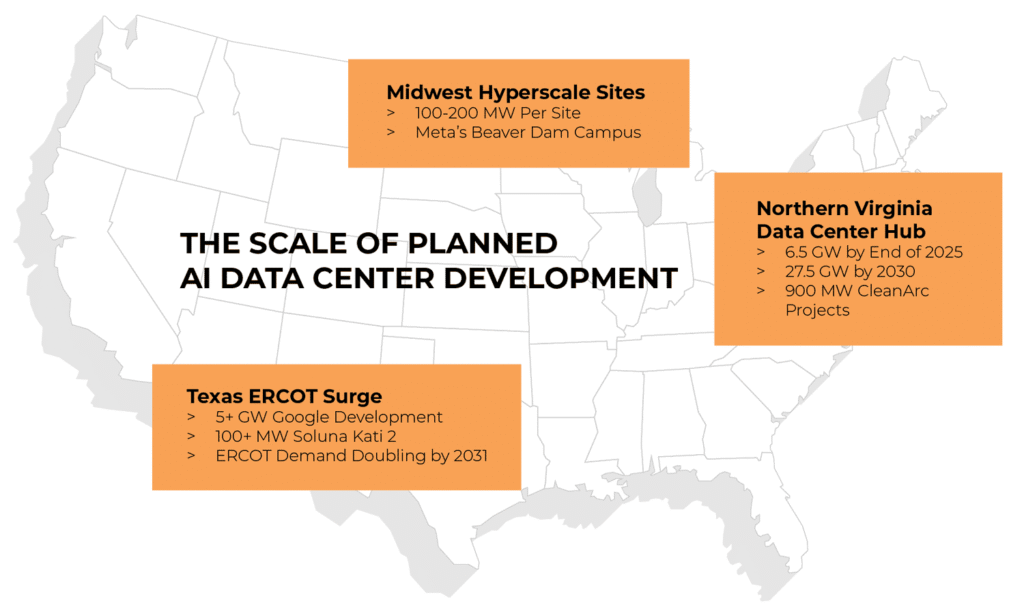
The impressive scale of planned AI data center developments drives this home:
- Northern Virginia is at the epicenter, adding ~6.5 GW by end-2025 and heading toward 27.5 GW total by 2030, with projects like CleanArc Data Centers delivering 900 MW blocks.
- Texas is accelerating rapidly under ERCOT, with sites exceeding 100 MW each—Soluna Holdings’ Project Kati 2 (wind-integrated, >100 MW for AI/HPC) and Google’s planned 5 GW across Armstrong and Haskell counties (~$40 billion investment) illustrate the scale. ERCOT forecasts statewide demand more than doubling by 2031.
- Other regions, including Wisconsin (e.g., Meta’s Beaver Dam campus in the 100–200 MW range per site), show hyperscalers clustering where power and fiber converge.
This explosive growth strains grid infrastructure built decades ago for steadier, lower loads. Utilities are accelerating investments in generation, transmission, and new substations, but large power transformers remain a critical bottleneck. Lead times for these units often stretch far beyond two years due to manufacturing constraints, material shortages, and surging competition for factory slots[2]. In this transitional window, existing transformers must reliably support higher sustained loads and more frequent peaks.
The Weakest Link
A modern self-healing grid can redirect energy quickly, but historically the real grid vulnerability has been medium- and high-voltage transformers. A single large transformer failure can pull hundreds of MVA offline—enough to trigger major disruptions for hyperscale or critical industrial loads. A 2024 CIGRE analysis of 848 transformer failures, pins the distribution clearly: bushings at 25%, active part (windings/core) at 52%, and on-load tap changers (OLTC) at 19%[3]. These are exactly the components where incipient faults show up first—capacitance shifts in bushings, partial discharge in insulation, gas generation from thermal or arcing faults.
Pushing assets closer to limits without continuous insight heightens the chance that an incipient issue escalates under load.
A Sharp Shift to Condition-Based Monitoring
Transformer fleets now expected to support highly dynamic, high-density loads like AI data centers can’t be inspected periodically. The risk is too high; fault issues typically develop slowly and remain undetected until they become catastrophic. Instead, condition-based monitoring (CBM) enables strategy built around continuous visibility rather than scheduled check-ins.
With CBM, warning signs are identified months in advance, creating a window for planned intervention rather than reactive response. That visibility also changes how utilities approach loading decisions. During peak demand periods, engineers can rely on real-time condition data to determine whether a transformer can safely handle additional load. Instead of operating conservatively across the board, they can make targeted, evidence-based decisions—maximizing capacity where it’s safe while protecting at-risk assets.
The downstream impact of CBM is significant: lower maintenance costs driven by better timing and prioritization, plus a more strategic approach to asset management overall. Rather than managing transformers based on age alone, utilities can prioritize investments based on actual condition and risk, aligning capital spend with real system needs.
The ultimate payoff? Maximized fleet lifespans and more efficient grid utilization.
Real Time Results
A field example illustrates the point: A ZTZ Services utility partner had a critical transformer displaying early deterioration, with replacement 16–18 months away. Taking it offline would have disrupted service to the connected load. Continuous monitoring—bushing capacitance trends, partial discharge activity—gave engineers daily visibility and the confidence to operate safely through the delay. No unplanned outage, no failure, and reliable service for the full period[4].
This wasn’t an AI data center load, but the engineering principle holds universally: CBM provides the evidence to extend reliable operation during extended replacement cycles, directly applicable to supporting high-growth, high-priority interconnections.
Strategic Context in the AI Data Center Era
Power availability—not servers or GPUs—has become the real constraint for new data center builds. Utilities often trail developer timelines by two years or more, forcing heavier reliance on the existing fleet. Transformers sit at the center of that reliability challenge.
Conclusion
The AI-driven demand wave isn’t going to be solved by new infrastructure alone—success will hinge on getting every reliable megavolt-ampere possible from transformers already in service while the broader buildout catches up. Condition-based monitoring, delivered through proven online systems for bushings, DGA, partial discharge, and integrated analytics, supplies the real-time diagnostics and risk control needed for safe, extended performance.
ZTZ Services’ U.S.-manufactured hardware, lifetime-warranted designs, and TraMos platform are purpose-built for this environment—turning continuous data into actionable decisions that strengthen grid resilience. If you’re evaluating ways to bridge capacity gaps without compromising reliability, exploring these solutions makes practical sense.
[1] Data Center Energy Usage Report Lawrence Berkeley National Laboratory, December 2024
[2] Wood Mackenzie 2025 analyses documenting average power transformer lead times around 128 weeks in Q2 2025 surveys, with persistent 30% supply deficits projected for that year
[3] CIGRE Technical Brochure 939 (WG A2.62, 2024, p. 51)
[4] https://www.ztzservices.us/case-study/deteriorated-h2-bushing-in-a-200-mva-auto-transformer/


