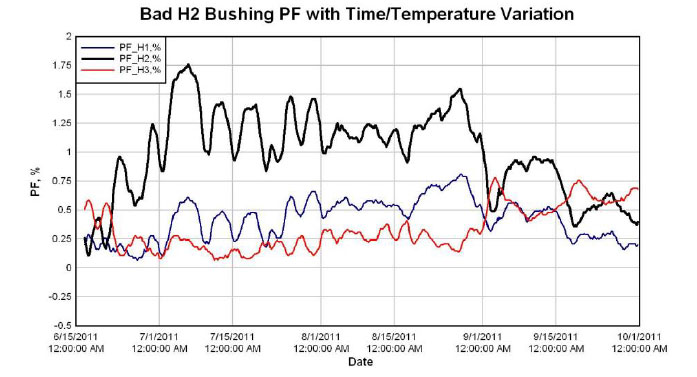
In this scenario, offline PF tests on a 230/138 kV, 200 MVA auto transformer revealed a “deteriorated” H2 bushing, with PF rising from 0.26% to 0.87% over two years—exceeding industry thresholds for replacement. The transformer supplied a mountain resort where the secondary source couldn’t meet summer/winter peak demands, risking extended outages if failure occurred.
ZTZ’s Technical Expertise
ZTZ recommended leveraging their continuous BMS to “ride out” the 16-18 week bushing delivery delay. Their expertise involved analyzing temperature-dependent PF trends, which showed higher PF at elevated summer temperatures (up to ~0.8% PF), indicating ongoing but non-catastrophic deterioration. This allowed safe re-energization while monitoring for escalation.
Evidence of Monitoring Use
The BMS tracked PF in real-time via test tap signals, providing confidence to de-energize only if trends worsened (e.g., the chart showed PF fluctuations tied to temperature, peaking at 0.8% in summer). Post-replacement during a scheduled outage (no customer interruption), all bushings stabilized below 0.5% PF deviation, confirming the system’s accuracy in minimizing outage risk.